KICKOFF
We had our Inspection kick-off on June 5th, 2018!
A Discovery and Framing phase happens at the beginning of all projects. The goal is to identify and prioritize challenges in the project, before development starts; Ultimately coming away with the requirements for building the MVP, or Minimum Viable Product.
.png)
During the Discovery Phase for which comprises the first diamond, potential problems and challenges facing the product are identified and discovered through workshop activities and user interviews. Participants then work to prioritize and converge these issues into a point where the Framing phase can begin.
The Framing phase consists of activities and workshops designed to find solutions to the problems exposed during the Discovery phase. Similar to how the previous phase identified many problems, then converged them, the solutions proposed during this phase are consolidated and prioritized until the requirements and approach to build the MVP are decided.
.jpg)

What does the Inspections process look like?
1. Initiation
-
Triggered by Source of Inspection (eg. Risk Analysis, Claim, Target Sector, and Blitz, etc.)
-
Confirmed Legal Entity
-
Assessment - Is this Eligible for Inspection? (If Yes, Inspector can proceed)
2. Contact Employer
-
Initiate Contact
-
Notice of Inspection
3. Site Visit (could be remote)
-
Employer and Employee Interview (Scripted Questions)
-
Test Audit
-
Self Audit
-
Compliance Order
-
Penalty/Ticket
4. Wrap Up
-
Inspector received Self - Audit
-
Notification of Compliance
-
Inspection Report posted at the workplace
5. Bring into Compliance
-
Issue OTP (Overtime Pay)
-
Possible Appeal
-
Fine $$$
-
Potential Collections
Persona
The Inspection tool has two users:
-
An Employment Standards Officer from the Ministry of Labour
-
An Ontario Employer / Employee
Exercise Goal:
Define the anticipated goals of the average user of our tool such that the team can build empathy and relate to this persona while working towards building a quality tool that will best meet end user expectations.
_edited.png)

Stakeholder Mapping
Exercise Goals
Stakeholder Mapping exercise allows the team to discuss and understand who our key stakeholders are, where they come from, and what their roles are for better communication and collaboration down the road. Essentially this exercise helps the team to fully understand the relationship of the stakeholders towards our Product. It provides the balanced team a map about:
-
who are the key decision makers
-
who have eyes on the product
-
who have the rights to refuse
-
who provide support to the product outside of the balanced team

Risks & Mitigations
Top Risks Identified
-
Data Sensitivity (Keeping data in the Cloud)
-
Decision Making Being Hindered By Long Chain of Command
-
Hard Deadlines + Timelines
-
Too much scope & not enough time
-
Interference with Other MoL360 Applications
-
Resource Availability
.jpg)
.jpg)
Exploratory Interview
Topic Map
The team has gathered notes and was given the opportunity to build empathy with actual users as well as take notice of topics that were repeated across multiple interviews. This data will be organized and synthesized for further use in determining/refining our proto- project goal and refining our personas to make them more aligned with our end users.
.jpg)
Interview SYNTHESIS
Once these groupings have been established for each interviewee, we perform the same task to determine our primary areas of interest taken from all 5 interviews. These latter groupings will denote the pain points/opportunities upon which the project will focus on an affinity map.
.jpg)
.jpg)

Desktop Walkthrough
Desktop Walkthrough Outcome
The team gained a better understanding of the finer details and manual requirements of the inspection process from having a former ESO, walk us through an inspection in chronological, start-to-finish discussions conducted within a typical interview.
This board included various locations (office, parking lot, subway restaurant) and was divided such that we could focus on inspections in distinct lifecycle stages in specific simultaneously.
ESO brought the inspection process to life before our very eyes as she moved her character about and explained her actions and thought process. We added post-its and pins to our board to denote the pain points and documents produced along the way, for easy reference while determining our primary development focus.
.jpg)

Pain Points Mapping
With the help of our PO, we were able to prioritize these pain points based on the value that would be gained by alleviating these. Then, with the help of the CM team (our Inspections sub-team!), we were able to determine how difficult each of these areas of frustration would be to solution. In the end, we ended up with a 2x2 matrix depicting this scenario :
.jpg)
.jpg)
Birds Eye View
)%20-%20Inspe.jpg)
The Lean Exercise - A Roadmap Exercise
Throughout the entire Discovery process, it was very common for our team to come up with several solutions what we believed we should immediately start building. Whenever someone on the balanced team had an idea, the solutions were added onto sticky notes and were hidden behind a "locked" Solution Chest.
The idea is that people tend to get fixated on defined solutions prior to discovering other underlying issues within the problem. So instead of immediately locking and working on an assumed solution from the get-go, it would be best to understand the bigger picture first. However, now that the team was in the Framing process, we "unlocked" the Solution Chest and to review the ideas from the D&F. We used the knowledge we gained from the previous workshops and interviews conducted with real users to validate and prioritize which solutions were on the right track.
We've gone through a trial run of specifying and establishing our priorities and placing them within a practice roadmap. This exercise allows us to think further upon the direction of the development of the Inspection tool in a trial-and-error manner. We can then use the experiences and shared opinions gathered from this workshop to cater our future exercises to further defining our highlighted priorities.
.jpg)


Scenario Writing

Sketching Workshop & DEsign Critique
We produced a scenario that can be enacted within our future software to provide value to the user, we need to begin to visualize how this functionality will look and feel. The goal is to provide a prototype with an intuitive flow such that users will be able to walk themselves through the scenario without needing help or training.
Sketching Workshop Process:
The sketching process works in the same fashion as the scenario writing workshop. Each individual is given a large sheet of paper and, within a 10/15 minute timeframe, they are made to draw out a storyboard that they feel would best encompass the performance of the specified scenario.
Once everyone has finished their drawings, we rotate these works of art around the table and let everyone individually review and vote on storyboard portions that they would like to use in the final prototype. In the end, we consolidate the most popular page sections and features which the designers can use in a high-fidelity mock.

.jpg)
Usability Interviews
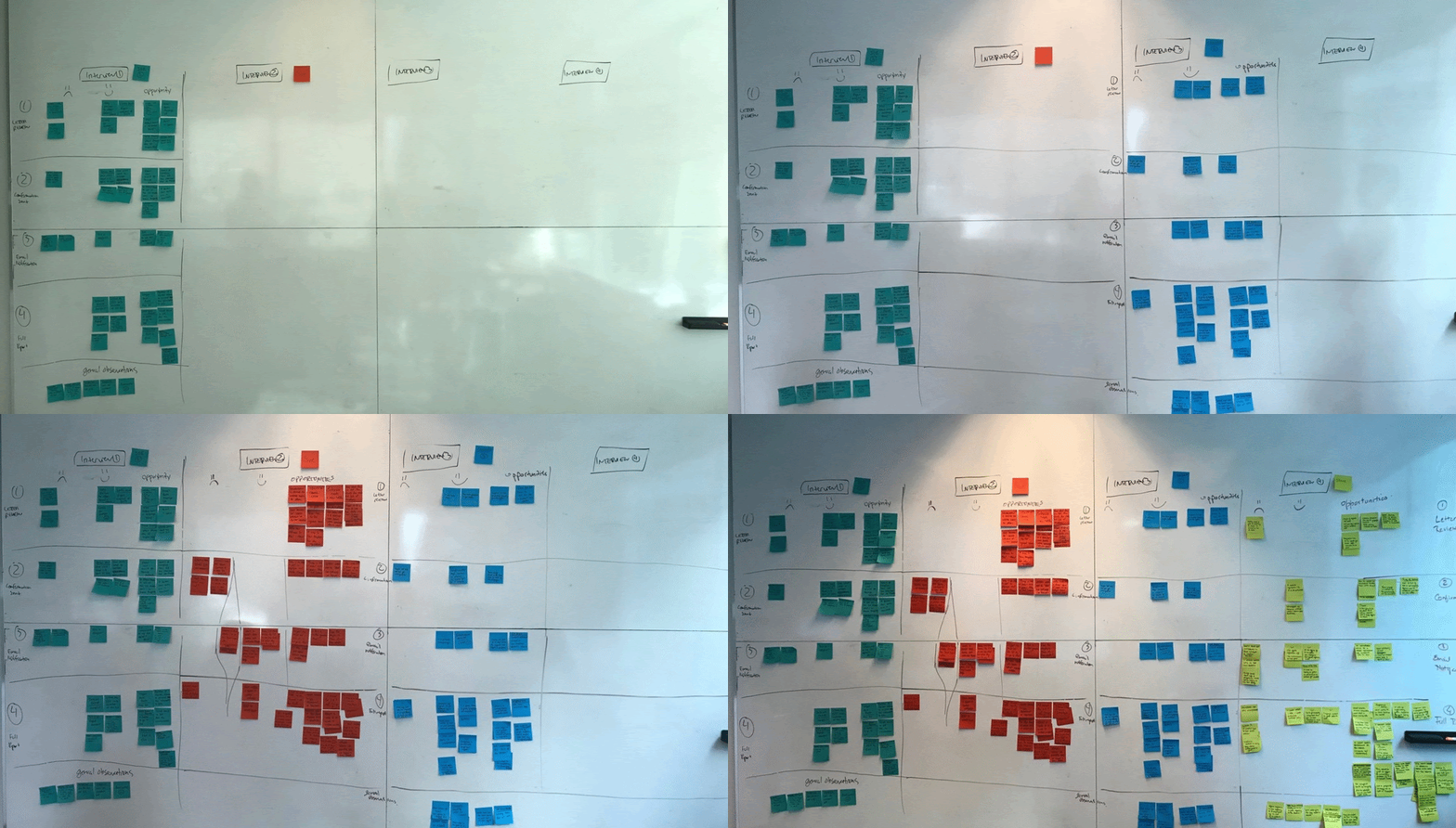
We captured the notes on a specific color for each user, review each user's post-its, and then look for patterns amongst all the users.
For our prototype synthesis, we created a grid on the whiteboard and organized post-its within each person, and by: Happy | Sad | Opportunities
Some High Fidelity Mocks & Final Design


